


The Benefits of Using Inverters with Batteries in Power Rooms
Power rooms are the backbone of telecom networks and electrical substation automation. Inside these rooms, rectifiers provide steady DC power, while many critical loads still require clean alternating current. When utility grid interruption, voltage sag or grid fluctuation happens, an inverter-battery backup system becomes the last safety line for mission-critical equipment.
A telecom power inverter converts stored DC power from battery banks into stable AC output. Most industrial models accept standard 48V DC or 110V DC input, matching the common DC bus of telecom and substation power plants. Unlike consumer UPS, rack-mount telecom inverters are designed for 24/7 continuous operation, hot-swap maintenance and N+1 parallel redundancy. Below are the core benefits of deploying inverters with batteries in power rooms.
1. Seamless, Zero-delay AC Backup During Grid Outages
When mains power drops, batteries feed the inverter instantly without transfer delay. There is no equipment reboot, no signal interruption and no flicker for connected AC loads.
This is extremely valuable for remote BTS towers, rural telecom sites and high-voltage substations, where grid stability is poor. Diesel generators need startup time, but the inverter and battery system provides immediate ride-through power. It protects relay protection panels, SCADA controllers, microwave transmission units, site monitoring hosts and emergency ventilation equipment.
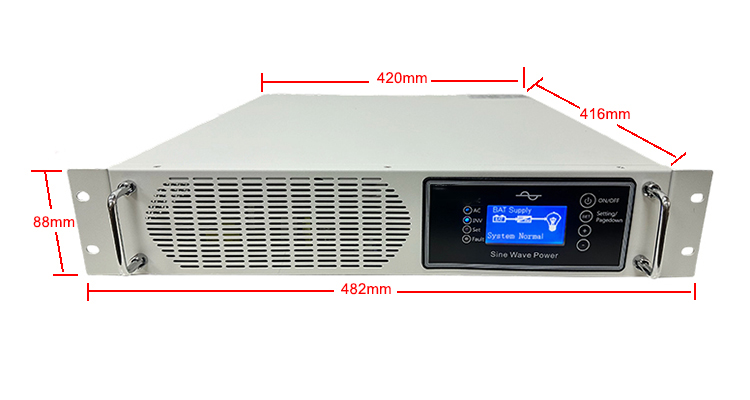
2. Clean Pure Sine Wave Output to Protect Sensitive Industrial Loads
Professional telecom inverters deliver low-THD pure sine wave AC power, identical to grid-quality electricity. Modified sine wave inverters create harmonic noise, overheating and signal interference, which may damage precision communication and protection devices.
For power room applications, clean AC power extends the service life of expensive automation hardware. It avoids false alarms on protection relays and communication errors on transmission equipment.
3. Perfect Compatibility with Existing Rectifier DC Power Systems
Most telecom and substation power rooms already run modular rectifier systems that float-charge battery banks. The inverter shares the same DC bus built by rectifiers, DC distribution units and battery strings.
This unified architecture simplifies the whole power scheme. You do not need a separate charging system or independent UPS cabinet. The rectifier charges batteries normally when grid is healthy; once mains fails, batteries supply the inverter automatically. It works well with 48V telecom power systems and 110V DC substation power plants.
4. Modular Hot-swap Design and N+1 Redundancy for High Availability
Industrial power inverters adopt standard 19-inch rack form factor, supporting parallel operation and N+1 redundant configuration. If one inverter module fails, other units share the total load without power cut.
The hot-swap function allows field engineers to replace faulty modules online. No site shutdown is required, which greatly cuts maintenance risk and service downtime for operators and power engineering contractors.
5. Remote Monitoring and Alarm Function for Centralized NOC Management
Qualified telecom inverters support SNMP, RS485, dry contact alarm and local LCD display. Facility teams in the network operation center can remotely check input DC voltage, AC output status, load rate, battery health and fault codes.
Early warning alerts help maintenance teams arrange repairs before total backup failure occurs. This smart monitoring feature is a big advantage for multi-site telecom operators and substation automation projects in Brazil, India and other emerging markets.
6. Lower Total Cost of Ownership Than Generator-only Backup
Battery-inverter backup systems have no fuel consumption, no regular engine oil service and less routine maintenance compared with diesel gensets. Modern high-efficiency telecom inverters reach 94%~96% conversion efficiency, reducing long-term power loss and heat generation in power rooms.
It acts as the primary short-term backup. The generator can be reserved only for extended blackouts. This combination reduces fuel cost, noise pollution and site logistics pressure for remote tower sites.
7. Space-saving Rack Layout for Compact Power Rooms
Space inside telecom cabinets and indoor power rooms is always limited. Rack-mounted inverters fit neatly into the existing power shelf together with rectifier modules, DC-DC converters and distribution units.